


When a listing expires, it signals something specific: an owner wanted to sell, hired a broker, and the property didn’t trade. The motivation is still there. What’s missing is a new plan and the right broker to execute it.
Expired listings are one of the most direct prospecting opportunities in real estate. The owner has already raised their hand. Your job is to show up prepared, explain what went wrong, and demonstrate why you’ll get a different result. This playbook walks you through how to do it in five steps using Marketproof Pro:
- Find expired and aging listings in your market – Surface the opportunities others miss.
- Research the owner and listing history – Understand the full picture before you reach out.
- Build your outreach approach – Lead with insight, not a pitch.
- Show them why it didn’t sell – Use data to diagnose the problem and present a new strategy.
- Follow up with new information – Stay relevant as the market moves.
Before diving in, keep three principles in mind: speed matters (the best window is the first few days after expiration), data wins the conversation (opinions don’t differentiate you, but comps and market context do), and empathy goes further than pressure (the owner just had a frustrating experience – acknowledge it).
Expired Listings vs. Market Coverage: When to Use Each
In our Market Coverage Playbook, we laid out the market coverage approach: pick a territory, build relationships with owners over time, and position yourself as the local expert before they decide to sell. Market coverage is a long game built on consistency and credibility.
Expired listings work on a shorter timeline. The owner is already motivated, the clock is ticking, and multiple brokers are competing for the same opportunity. Where market coverage rewards patience and depth, expired listings reward preparation and speed.
The strongest agents use both. If an expired listing falls in your coverage market, you have a significant edge: you already know the building, the comps, and possibly the owner. You’re not cold-calling – you’re following up on a relationship you’ve been building. And if you’re just getting started with prospecting, expired listings give you an immediate pipeline to work while your market coverage strategy develops.
Step 1: Find Expired and Aging Listings in Your Market
The first challenge is knowing when a listing expires and getting to the owner quickly. Most brokers rely on alerts or manual searches, which means they’re working from the same list as everyone else.
Marketproof Pro gives you two purpose-built tools to stay ahead: Recently Off Market and Aging Listings.
Recently Off Market: Catch Listings the Moment They Expire
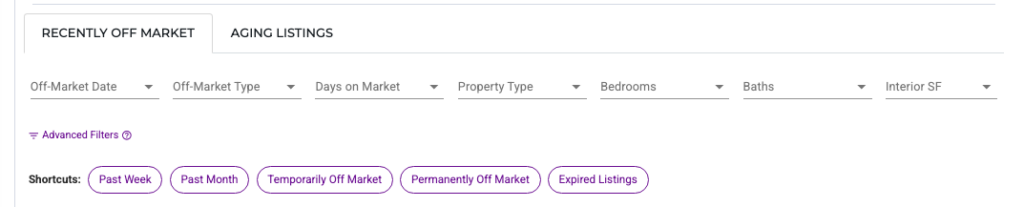
Recently Off Market surfaces properties that have just come off the market. You can filter by off-market date, off-market type, days on market, property type, bedroom count, and more. Built-in shortcuts let you instantly pull up expired listings, permanently off-market properties, or temporarily withdrawn units from the past week or month. When a listing expires, you’ll know immediately.
Aging Listings: Get Ahead of Expirations Before They Happen
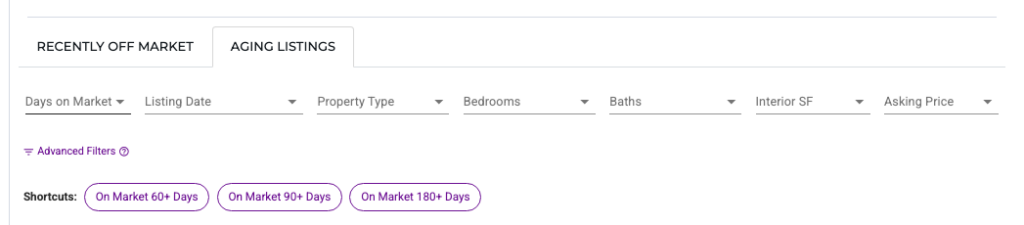
The smarter play is often reaching an owner before their listing expires. Aging Listings identifies active listings that have been on the market for 60, 90, or 180+ days without a contract. You can filter by days on market, listing date, property type, asking price, and unit details. These are the listings most likely to expire soon, and the owners most likely to be frustrated with their current broker. Getting in front of them early means you’re having the conversation before the competition even knows there’s an opportunity.
Start by setting up your target market in Marketproof Pro. Use Aging Listings to monitor properties that are stalling, and use Recently Off Market to catch those that have already expired. The brokers who win expired listings aren’t reacting – they’re already watching.
* * *
Sign up for a free 7-day trial to use Owner Outreach and the rest of Marketproof Pro.
* * *
Step 2: Research the Owner and Listing History
Before you pick up the phone or draft an email, you need to understand two things: why the listing didn’t sell, and who the owner is.
Start with the listing history. In Marketproof Pro, you can pull the full transaction and listing record for any unit. Look at the original list price versus recent comps in the building. Check how many price reductions occurred and when. Review the days on market relative to the building and neighborhood average. These details tell a story – was it overpriced from the start, poorly marketed, or simply caught in a slow stretch of the market?
Then research the owner. Marketproof’s Owner Outreach surfaces the owner’s contact information, including email, phone, and mailing address. For LLC-owned properties, it identifies the individuals behind the entity. It also provides background context like work history, education, and social profiles – the same details that help you tailor a cold outreach into something that feels relevant and personal. (Read more about how Owner Outreach delivers better results than traditional skip tracing.)
The combination of listing data and owner context is what separates a thoughtful approach from a generic “I see your listing expired” call. When you can reference the specific pricing history, explain what the comps actually support, and speak to the owner as a person rather than a lead, you’re already ahead of every other broker who’s dialing the same number.
Step 3: Build Your Outreach Approach
Expired listing owners are going to hear from multiple brokers, often within hours. What you say and how you say it matters more here than in almost any other prospecting scenario.
Phone: Lead the Conversation with Data
The phone is usually the primary channel for expired listings because of the time sensitivity. But instead of opening with “I noticed your listing expired,” open with something specific: reference the unit, the building’s recent activity, or a comp that closed since they listed. The goal is to signal immediately that you’ve done your homework and aren’t reading from a script.
Email: Deliver the Full Picture
Follow up your call (or lead with an email if that’s your strength) by attaching a data-backed asset. A unit-specific comp report generated in the Marketing Center shows the owner exactly where their property sits relative to recent sales. Pair it with a brief note explaining what you see in the data and what you’d do differently. This gives the owner something to review on their own time and share with anyone else involved in the decision.
USPS Mail: Stand Out from the Digital Noise
A printed comp report or a personalized letter sent to the owner’s address can cut through the flood of emails and calls they’re receiving. It’s tangible, it signals effort, and it gives you another touchpoint in a channel most brokers ignore entirely. The Marketing Center lets you generate print-ready materials directly.
The right channel mix depends on the situation. For a high-value listing that just expired, you might call the same day, email a comp report that evening, and mail a printed market analysis the next morning. For a listing that’s been off-market for a few weeks with less competition, you might lead with a thoughtful email and follow up by phone. Match your approach to the urgency and the owner’s profile.
Step 4: Show Them Why It Didn’t Sell
This is where you win or lose the listing. The owner’s core question is simple: Why didn’t it sell, and what will you do differently?
Use the Marketing Center in Marketproof Pro to build your case at three levels:
Unit-Specific Comp Report: Pull a comp report for the owner’s unit that shows a projected sale price range based on comparable recent sales. If the previous list price was above this range, the data makes the conversation straightforward. If it was within range, you can point to other factors – timing, marketing approach, or market conditions during the listing period.
Building Report: Show the owner how their building has been performing. Include the last 24 months of transactions, price per square foot trends, and inventory levels. This puts their unit in context and helps them understand whether the issue was property-specific or building-wide.
Market Report: Zoom out to the neighborhood or submarket. If the broader market softened during their listing period, the data shows it. If the market was strong and their unit still didn’t move, that points to pricing or presentation – and you can address both.
When you walk an owner through all three levels, you’re not giving them an opinion. You’re giving them a framework for understanding what happened and a data-backed plan for what comes next. That’s what earns trust and wins the listing.
* * *
Sign up for a free 7-day trial to use the Marketing Center and the rest of Marketproof Pro.
* * *
Step 5: Follow Up with New Information
Not every expired listing closes on the first conversation. Some owners need time. Others want to wait for the market to shift. The key is to stay in the conversation with something new each time you reach out.
When a new comp closes in their building, send it over with a quick note on what it means for their unit’s value. When market conditions change – a shift in inventory, a seasonal uptick in activity, a change in interest rates – share a brief update tied to their property. Each follow-up should deliver a new data point, not just a check-in.
Marketproof Pro makes this sustainable. Because you’re already tracking the buildings and neighborhoods in your target market, you’ll see new activity as it happens. A closing in the owner’s building becomes your reason to re-engage. A new listing at a comparable price point becomes a conversation about timing. The platform gives you the raw material; your job is to turn it into a relevant, timely touchpoint.
Track your follow-ups and the owner’s engagement. Note which assets they respond to, whether they open your emails, and how the conversation evolves. Over time, some of these owners will re-list – and when they do, you want to be the broker they’ve been hearing from consistently with insight they can’t get anywhere else.
Getting Started
You don’t need to work every expired listing in the city. Start with the buildings and neighborhoods you already know or are actively covering. Set up your Aging Listings filters to watch for stalling properties, and check Recently Off Market daily for new expirations. Pull the listing history for a few units, research the owners, and generate your first comp report. Make one call, send one email, and see how the conversation goes.
If you’re already running the market coverage strategy from our Owner Outreach Playbook, expired listings in your coverage area are a natural extension of the work you’re already doing. You have the data, you know the buildings, and you may already have a relationship with the owner. That’s the strongest position you can be in when a listing expires.
Sign up for a free 7-day trial to use Owner Outreach, the Marketing Center, and the rest of Marketproof Pro.